

The Mental Tools - Lesson 2
Understanding The Energy of a Wave
In Lesson 1, I shared Skip Fry’s spoon experiment under the heading of Curiosity. I believe that curiosity is the shaper’s greatest asset. Further, to remain curious (particularly as you get older) is to remain fully engaged in life. I hope never to lose my curiosity.
I am perplexed by waves; how the energy moves through the water and propels surfers. With that I mind, I’d like to share some of my experiences of catching waves.
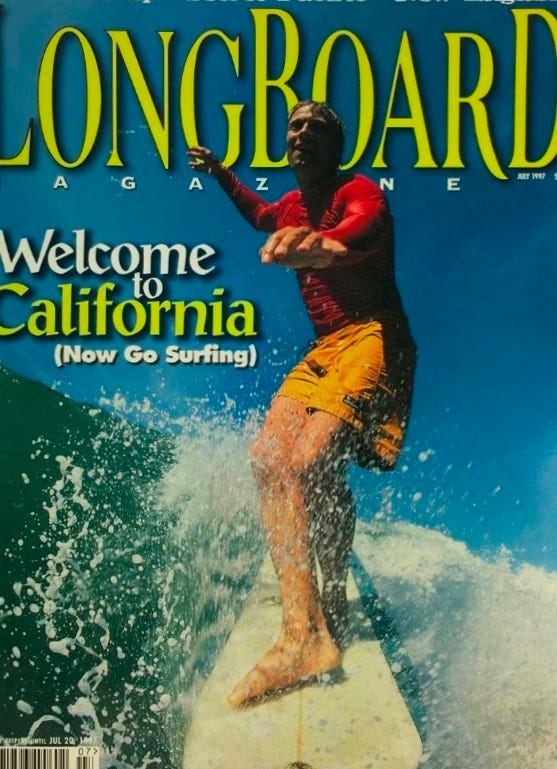
In the late 1990s, my friend Jim Russi, the great surf photographer (and at that time photo editor for the Longboard Quarterly Magazine) had an idea for getting the perfect hang ten shot. He had a custom mounting made for his camera which would hold the camera several feet in front of the surfboard, pointing back at the surfer. A bar was made to hold the camera mounting and attached to the underside of the nose of the board. Donald Takayama made a thick ten foot board and the mount was bolted into the board. It was quite an undertaking to put this together at that time.
When the right day finally came, I paddled the board out and Jim was on shore with a remote control to the camera. It was very awkward to paddle because the camera was heavy on the end of the bar, and it was at least two feet out of the water. After trying for the first two waves, I realised I had to sit much further out than the others, way behind the peak. The board caught the swell much earlier than I had expected and was very fast across the swell. It seemed I had entered another dimension of surfing. I was going so fast across the swell and was able to do carving turns where my normal board would just be picking up the wave.
Now, nearly thirty years later, I see foils carving on that part of the swell, though the dynamics are very, very different. There is more to a wave than thinking of it as a steep face, there is a deeper energy.
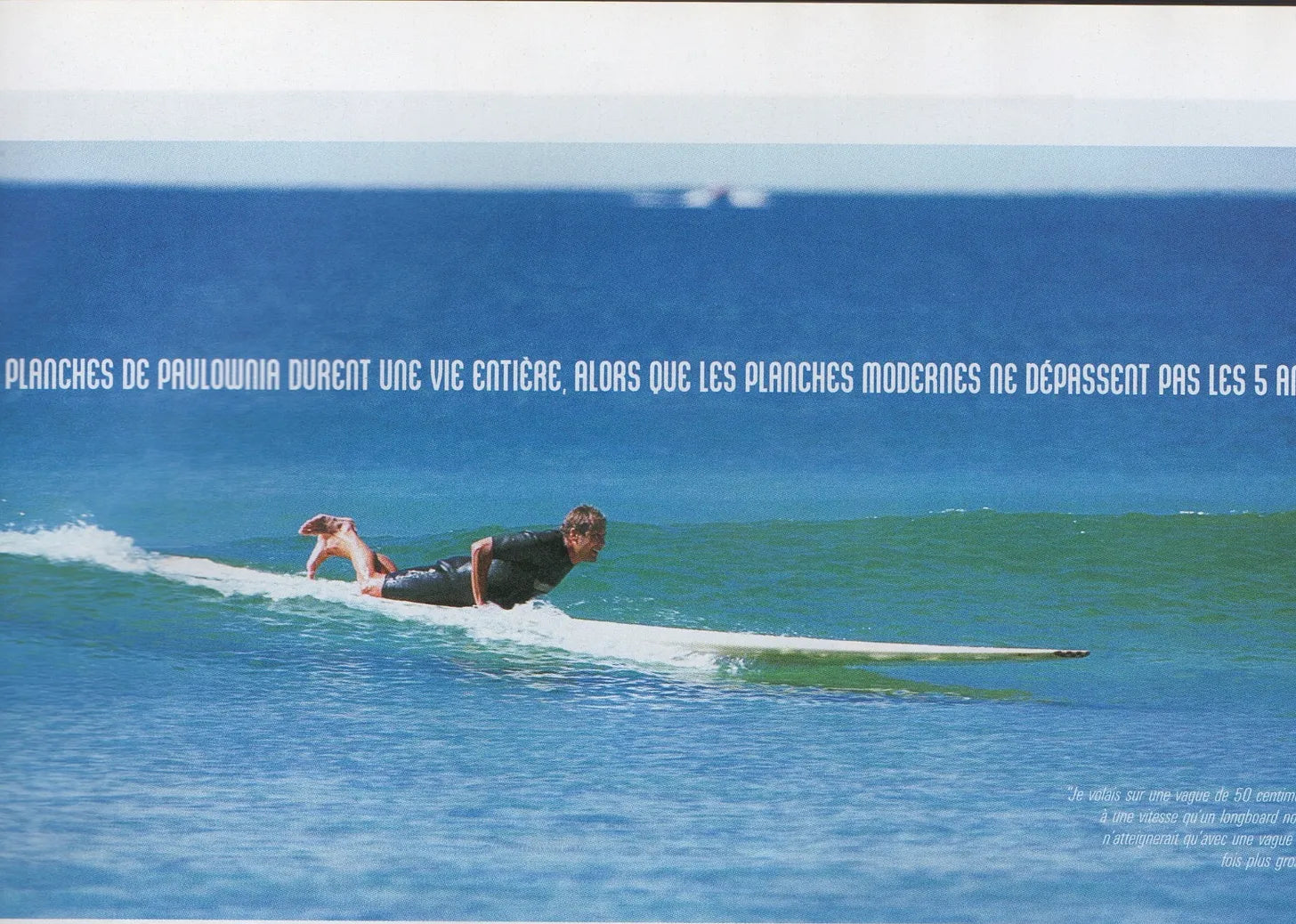
When I began the Alaia journey, learning about ancient Hawaiian surfing, I wondered how the Hawaiians paddled into waves on a very heavy koa-wood alaia. Koa is heavy (it barely floats) and even though the ancient boards were very thin and made with concaves, it seemed to me it would be nearly impossible to paddle one into a wave. In 2015 I had the opportunity to go to Papua New Guinea and make wood surfboards at the Tupira Surf Camp. One day I went to a remote little river mouth where the local surfers enjoyed a great sand bank. There were no foam boards, nor had one ever made it to this area. The kids boards were reshaped from canoes and were basically waterlogged. They were heavy. They would paddle out on the boards, however when a wave came they didn’t paddle into the wave. They pushed the wood board out in front of them and kicked. As the swell lifted their feet then their body, they lifted the wood board up out of the water. Then, as they kicked down the steepening wave the weight of the board seemed to pull them into the swell similar to the way the camera mounting on the front of the Takayama pulled me into the wave. One of the kids tried my light paulownia board and could not catch a wave in the same fashion. I felt I had witnessed a totally different technique to catching waves and been given an insight into ancient surfing.
Conversely, I wonder about the underwater takeoff when bodysurfing. If we do not swim into the swell and actively stiffen our bodies in the proper shape, we will do nothing - like a bag full of water, as we are mostly water. However, if we position ourselves just right, in the breaking swell and kick like David Rastovich, we can ride inside the swell. I think the key is that we have to stiffen our bodies, bending slightly and making a reverse rocker; we are not flat, but bent into a semi-circle with head down. When I see dolphins riding in the waves they are like this. Riding inside the wave is very different to sliding down the face of the wave. Different wave forces are at work.
I have spent years wrestling with making finless surfboards from modern materials. I love the feeling of a flexible board, however the more flex, the harder it is to catch the wave. As the wave lifts the tail, there is no resistance and the tail floats over the wave rather than feeling the forward push of the wave. I had a lightbulb moment when I watched JJ Star win the finless division at the Noosa Festival of Surfing in 2012. He was standing on a board of his own design, a custom made boogie board with reverse rocker. In the small waves, the reverse rocker caught waves earlier than the longer boards and went faster. I was inspired by this and I put the reverse rocker in my finless boards and found I caught the wave much earlier. Finally, I put 5 inches of reverse rocker into the tail of a 9 foot flexible finless board and I could not believe how early I could catch the wave. I was up and standing where I would still be paddling on a 12 footer. As the swell hits the back of the board, the tail floats up and creates tension with the energy inside the wave. The board is pushed forward. It was like kicking with a fin. (Note: finless boards can have reverse rocker and not pearl because as the board starts sliding down the wave and the rider stands up, the tail drifts and the board becomes parallel with the wave. The rails act like long fins holding the board into the wave more parallel than a finned board).
Imagine a beach ball floating over a steep wave. It doesn't engage with the wave. Now imagine the beach ball attached to a stick that you are holding and you try to push it under the steep swell. It would push back with great force. There is an energy inside the wave pushing forward as the wave begins to feel the bottom. When body surfing you engage this energy.
Most modern surfing is more about sliding down the face of the wave. It is more like skiing on snow as the board planes across the water surface with the fins penetrating the surface. The foils of the board react with the water as the board goes across the wave which defines how the board rides, but it is not the energy from within the swell. When you are in the tube, zooming along, consider that all the energy of the swell is going over your head. When you come out of the tube and you are in the whitewash, you are bouncing around in the same energy, just in a turbulent form. When I watch the foilers ride an ocean swell, I see the swell as a moving hill. As the water goes up, the foil slides down. The foiler goes at wave speed and can never outrun the wave unless the rider pumps to go faster. When the swell reaches shallow water, the front of the swell slows and the back pushes forward. It is this interaction where the energy of the wave transforms from quiet stillness to the fast moving, turbulent power expending itself before reaching the shore.
Margie and I love riding our wood bellyboards. We experience the energy of the small waves we ride by launching into the swell, feeling it rise as we plane across the surface, then we immerse ourselves in the energy of the wave as the back goes over the front and breaks. The full energy of the wave is enjoyed, even in small waves. Each ride is an amazing, magical experience.
Noseriders get their speed from the energy inside the wave. They are displacement hulls which work best when the round rail is pulling the board into the wave and the inner forces of the wave are pushing the board forward. That is something else I look forward to discussing soon.


Leave a comment
This site is protected by hCaptcha and the hCaptcha Privacy Policy and Terms of Service apply.