

The Mental Tools - Lesson 4
Basic Elements of Surfboard Design - Floatation & Volume
When I think of volume, the first thing that comes to mind is comfort. The more volume you have in a board, the easier it is to paddle and catch waves. Perhaps this is me showing my age, but when I think of a perfect surf, I see myself surfing in rolling waves with a 12 to 16 foot surfboard under my feet, gliding and doing long carves. Volume gets you into a rolling wave earlier and the long paddle back out is easier. But, these conditions are not common and in most surf conditions extra volume is not helpful.
Generally, modern surfing is about making the board as thin and responsive as possible, keeping just enough volume to help in long paddles. I spent four years primarily riding Alaias (2005 to 2009). In the end, I was mostly making and surfing Alaias around 5'6 x 15 1/2" wide x 3/4" thickness. They had minimal volume, but wow, were they amazing on a wave! Eventually, the exhaustion from paddling these boards and the strain on my body led me to rethink the ancient design. From 2010 to 2012, I worked on creating finless Alaia style boards which had foam and were easier to paddle. I called it the Seaglass Project. My shaping journey then, was about finding the trade-off of the wonderful intimacy you feel with the wave and the ocean on a thin piece of wood verse the comfort and ease of paddling a board with volume.
In 2018 Tom Curren was experimenting with putting fins on skim boards. His goal was intimacy and speed but he too was tiring of the low volume paddle out. He had glued chunks of foam to the deck of his skim board, but this wasn't working out. Tom came to my factory and we worked through three versions of his design (Tom had surfed my Alaias several years earlier). Tom would try the boards during the day and at night I would add foam and cork to the deck and he would try it again. We tried different flex patterns and fin placements as well. He was happy with the boards, but my method for using cork was still in the experiment phase and the boards soon became heavy, absorbing water into the cork. I have not seen Tom on a finned skim boards since then, but I love the way he is still very engaged with experimental shapes, especially fins. Full story from 2018 here.
For shortboards, it seems the right volume is a board that you can paddle easily, but can still duck-dive under the waves you usually surf. Too little volume and surfing it is tiring. Too much and you can't duck-dive, then you are on a mid-length.
For a mid-length board, you hope to maintain an intimacy with the wave. That is you can feel the energy of the wave and slight adjustments in your body flow through the board and the board reacts. You hope to have a stream of consciousness about the surfing. The key factor is having rails that are not too thick and round. These do not react quickly and are hard to control.
There are two subtleties to volume. First is, where the volume is on the board. If the front half has more volume, the board will surf better in over-head waves and will engage in longer, more powerful turns. Second, if the volume is toward the tail, then it will turn quicker, but may skip out of the water on bigger waves and lose traction.
Thirty-five years ago I was a team rider for Donald Takayama. We were talking about our favourite Noseriders and I said I do not like concave in the nose. I asked Donald why he put concaves in the nose and he said it was for turning. He said less volume in the nose let you turn the board from the tail easier. I was not expecting this answer.
The last aspect is rocker. The more rocker, the looser the board will be for turning, but it also makes it slower to paddle and harder to catch waves. With Noseriders, there is lift or rocker in the tail. This helps the board hold itself into the wave while the rider is on the nose, however, it makes the board slower to paddle and catch waves. There is a strong temptation to add volume to high rocker boards to help them paddle, but it often makes the boards too corky and the rails too thick which takes away from the advantage of the high rocker.
These days, thanks to shaping machines, we can more accurately measure the volume of a surfboard in litres. However if you don’t have an understanding of the effects of volume, including the placement of volume, these figures are hyperbole.
When thinking about floatation and volume ask yourself these questions;
How much time do you like to spend paddling?
How surf fit are you?
How intimately do you want to feel the wave?
Later, we will talk about how to measure rails and develop an understanding around measuring volume in relation to rail shapes; the two are connected.
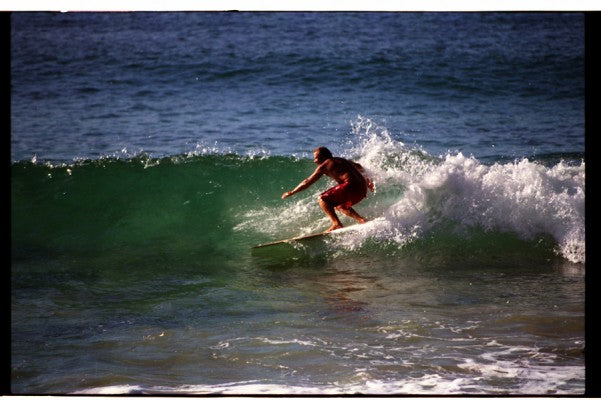
This alaia in this photo is 6'4 long x 14 1/2" wide x 3/4" inch thick. Surfing it brings a very intimate feeling with the wave. Pic by Ryan Heywood at Nationals, Noosa 2006

Leave a comment
This site is protected by hCaptcha and the hCaptcha Privacy Policy and Terms of Service apply.