

Suction + Tension = Hang Ten
Walking on Water
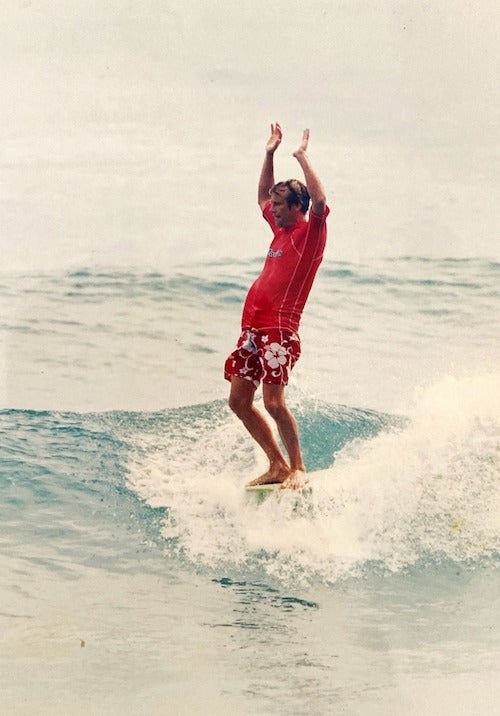
Photo: Old Mal Division at Noosa Festival of Surfing 2000; a knifey-railed potato chip from the 1960s, a 10’ Woosley 399 Model. Photo by the late and great, Geoff Potter.
In the smoky theatre’s of the early 1970’s, I saw my first classic noserides. As a sort of intermission in the very early shortboard movies, old noseriding surf footage was dubbed in. Maybe it was filler, maybe for historic interest. Maybe it was put there to show how far modern surfing had come. The theatre usually went silent and the high-vibe was lost. I loved these old shots. They always stuck in my mind but I thought I was alone. Twenty years later, I found that lots of kids were held speechless at the old dance.
In the Early 1980’s my crew mostly rode old longboards and I gained a love for the nose. The boards were cheap and very accessible. We watched the old movies and mimicked the old styles. It did not take long to find which shapes rode the nose better than others. I shaped lots of light longboards but I never found them to be as much fun to ride as the old ones.
With the rising popularity of longboards and competitions in the late 1980’s, I became very involved with the modern longboards. I was a team rider for Donald Takayama and every week our boards were progressing. One day I brought a new Takayama to the old home break and my best friend Bill Burke had a try. I had just seen him pull a beautiful hang ten across a wall on his 1964 Del Cannon. He got on my board and was approaching the noseriding section. Just as he wrapped his toes over the tip, the fins let loose, the board spun out, and he had a face of disgust as he hit the water. I remember this so well. The next decade of my life was dedicated to finding a board that would both noseride and turn off the tail like a shortboard. The boards I rode were very good and worked great on most days, but would then fall short on lots of others. I would walk the nose and see where I wanted to go but I just couldn’t get there. This was a frustrating time for me.
This episode came to a climax while shooting the movie Siestas & Olas in Mexico. We had lots of time to surf perfect waves and I really got to know the boards I brought, however I did not have a proper noserider. There we were at Perfect River Mouth #27, a flawless waist-high, peeling, left and I did not have a board that would allow me to wrap my toes over the tip and fly down the point. For days I cursed myself for not bringing an old board. I sat on the beach, maybe for the first time, and thought hard about what would make the ultimate noserider. Going back through all the old boards I had ridden I began to ponder what the old shapers were thinking about when they shaped those big gems.
For two years I shaped and studied board designs and formulated ideas about suction and water flow, and how noseriders ride though the water more like a dolphin than a speedboat. I was travelling through Noosa, Australia, when I found myself in a whirlwind romance with a beautiful girl and we were married in four months. Soon I had a planer in my hand and one of the best noseriding waves in the world at my doorstep. With a great group of friends and team riders, we set out to create the best noseriders based on the Suction + Tension theory. The boards performed just as theory dictated. The pieces of the puzzle fit. I felt like I had come so far. It was like going on a long surf trip to an uncharted area and coming over the last sand dune to find a small crowd in the water. My efforts in board design only brought me to where the shapers of years ago had left off.
Suction + Tension = Hang Ten
As we look through the magazines we see lots of photos of the Hang Ten. Virtually all are impressive, yet certain types are more impressive than others. These are the ones where the rider is far back in the pocket in the most critical part of the wave, but they look calm and poised. The board is in perfect trim while the front of the board and rider are hanging above the water. Upon closer inspection it looks impossible. How does it happen? Let’s take a deep look at the forces at work.
Suction
First, to get ten on the nose, the board must be sucked into the wave. Gentle curves change water flow over the board and create suction. Round rails suck water over the deck of the board. The weight of the water helps stabilise or counter balance the board so the rider can get there, and stay on the nose. Also, curve through the bottom of the board will suck the board to the wave. This suction from the bottom of the board starts happening when going fast due to the long bottom curve. To see how suction works, take a spoon and put the rounded end under the faucet (see Lesson 1). If you have never done this, you may be shocked by how much the spoon is sucked into the stream of water. The same forces make hanging ten possible.
Three Types of Hang Ten Boards
The Modern Longboard
The modern longboard is characterised by having a flatter bottom, a hard edge through the tail, a wide nose for noseriding, lots of rocker and a light glass job. They are easy to noseride and hang ten, but they noseride best out on the shoulder and in soft sections. When on the nose, the board points about 45 degrees towards the shore.
The modern board will hang ten because the thickness and width of the nose provide floatation and planing area, and the soft rails from nose to midsection suck water onto the deck. This stabilises the board within the wave and counter balances the person on the nose. This is a stable situation until the wave becomes too steep. As the wave gets steeper the board will become more parallel with the wave and speed up. As the board speeds up it begins planing on top of the water and the tail will not suck water onto the deck. Due to the hard rails through the tail and the flat bottom, there is no curve to suck the board to the wave. The rider must back pedal off the nose or else the board will literally fall out of the face of the wave.
The modern longboard will not noseride on a steep face because most of the board is geared toward releasing water and planing. Its speed is generated by planing down the surface of a steep wave. The board is designed to be smashing the lip on a steep wave and not hanging ten.
The Potato Chip
In the late 1990s, the knifey-railed potato chips of the late 1960s were popular at the Old Mal Rallies. Guys like Chris De Aboitz, Gareth Donovan and Ian Williams would rip on them. They’re characterised by thin rails, medium rocker and roll through the bottom, with a single fin. They will noseride much closer to the pocket than the modern longboard and they will go a long way before spinning out. One characteristic is that in a solid ten pose, the tail and fin will often be hanging out the back of the wave.
The roll through the bottom of the board sucks the board into the wave. The knifey, less buoyant rails easily cut into the wave and water is still sucked over the rail. Most of the board is truly within the wave in the hang ten position. Due to the rocker in the board and the suction, the board points toward the shore at about 35 degrees. The rail and the fin will pop out the back of the wave because the board is not parallel with the wave; besides, the wave is not as thick in the pocket as compared to the shoulder where the modern longboard noserides. When the board is in perfect trim and the rider is hanging ten, the curves working with the buoyancy will leave the fin and tail high and dry out the back of the wave.
The Soft-Railer
The soft-railer is characterised by the rounded rails, flatter rocker (except for lift in the tail), heavier in weight, hips towards the tail and a big single fin. Although this board has been mocked for over 30 years, it will do one thing clearly better than any other surfboard; it will hang ten beautifully and confidently in perfect, spinning, small surf.
Where the progressive flat bottom, light board gets its speed from the steepness of the wave and planing, the soft-railer gets its speed from tensions pushing against the board from within the wave. The wave wants to push the board towards shore, while the fin fights the wave and holds the board in the wave. This tension pushes the board through the water and across the wave. Soft-railers go through the water, while modern boards skim on top of the water. (Of course, each and every board moves because of a bit of each of these principals, but planing vs. displacement hulls is an accurate way to think about longboard design).
A big fin creates more tension and thus more speed. A big, thick fin works best. (It takes a big wave before the fin will create more drag than speed). The size of the fin has little if anything to do with the looseness of the soft-railer. It is all about fin placement, foil and tail design.
Having hips towards the tail is the key to the ultimate noserider. The hips make the board ride more parallel to the wave. When you are on the nose where the board is, say, 18 inches wide, while it is 23 inches in the hips, the attitude of the board will be more parallel with the wave thus making you travel faster across the wave. The flatter or straighter the board, the more parallel it can ride. With more width and foam in the back half of the board, there is more floatation and volume. This mass creates more tension with the fin and makes the board go faster. Also, it counters the suction created by the soft rails and lift in the tail.
With a properly balanced soft-railer, the elements for the hang ten are in the tail. As the board speeds up across the wave, the tail will suck into the wave and the nose will begin to lift up. Even while hanging ten the board will accelerate, climb in the wave and become more stable. This is how some people are seen hanging ten in such critical sections, where the front third of the board is out of the water while the rider is calm, poised and in complete control.
Technique
Since the world at large seems to be discovering longboarding with its emphasis on being able to ride the forward portion of the board, we’ve seen some pretty bizarre techniques employed to achieve that end. Everything from crabbing, shuffling, jumping or “scooching” seems to be fair game. Sometimes they actually make it to the nose for the “Kamikaze” in the shore break, while others suffer the ultimate ego-busting walking-off-into-space-wipe-out and some, the more excruciatingly, soul-destroying board between the legs, “Noogey-Crusher.” Ohhh!
In spite of the difficulty of achieving “The Holy-Grail” of longboarding, the hang ten is within the reach of anyone who really wants to take the time to learn the technique.
Example. Those surfers who have always ridden a shortboard have the biggest obstacle to overcome. Shortboards have to be brought off the top of the wave in order to continue down the line. When these surfers complete their turn, they bring the board off the top and then start towards the nose. Wrong! They end up walking the nose straight into a nose-dive.
Once you understand that the longboard will bring itself off the top of the wave by its own volition and gravity, you’ll be walking the board as it climbs out of the turn. In actual fact, a good noserider will be on the nose before the board has climbed to the top of the wave, riding the nose through the end of the turn and then on into trim, high in the wave and on down the line.
There are three different types of Noseriding: The Stall, The Forward Trim, The Next Step
The Stall
The easiest way to get to the nose is to wait for a small section to build in front of you, then stomp on the back of the board to slow it down. While the board is high in the wave and ready to accelerate through the section, you run to the nose and hang some toes over. You look like a champion for a few seconds, but it seldom lasts long. The board quickly loses its stability as the wave gets steeper and the board speeds up.
This is great way to practice for noseriding. It helps get the footwork down and to feel comfortable further back in the pocket. It is also great for contests where judges are often impressed with the quick noseride. In Australia a noseride is a point. But it is seldom the way to start a stunning hang ten.
After the stall, there is water over the deck of the board to hold the board in place. A wider nose allows flotation so a person can stand there for a short time before sinking. For a few moments, the noseride is stable, but as the board speeds up the dynamics change and suction has to start happening or else either the wave will get too steep and the board will fall out of the wave. Or the board will not accelerate, it will start to sink and you will lose the wave. I will have to say that there are few surfers good enough to be able to hang ten after a full stall and stay there as the board takes off. I have found that I have to sort of hold my breath for a few moments and wait for the wave to get very steep. At that point, I press down on the inside rail to climb higher in the wave and try to make the board accelerate as fast as possible. If I hang there too long, without getting the suction happening, the fin usually comes out of the water, there is a big splash, and I start swimming for my board!
Picture the wave lining-up in front of you. In order to gain speed and trim, you’ve got to step forward. Then the critical decision comes. Do you...
A. Step back and use the speed to smack the lip
B. Stand there, feel the speed and energy of the trim, and love it
C. Take the next step to the nose
The correct answer is B. However, if you choose C, you have to take a good look down the line and see what the wave is going to do.
On the other hand, if you are into side slipping and helicopter manoeuvres, this approach is for you. After the stall, you can run up and hang ten for a moment, then take a half step back and catch your balance. If your board has hard rails, the fins will come out and you can swing them all the way around and pull the helicopter. In the 1980’s this single manoeuvre dominated the contests scene (the side slip boogie) and nearly destroyed the credibility of modern longboarding.
The Forward Trim
A long noseride in trim takes preparation. First, you must have a feel for your board. The board’s dynamics dictate where you will go and what you will do. As discussed earlier, the flat bottom/low-rail boards will noseride further out on the flatter sections while the soft-rail boards will hang ten in the steeper sections. On the flat-bottom boards, when you are looking down the line and a nice section is forming, the best rule is to ‘charge’ the nose early. The basic goal is to stay on the nose as long as possible before the wave gets too steep. On a long, slow point you can hang five for a long time, or if you are very light, hang ten. The downside is that as the wave gets steeper and things start to get exciting, you’ve got to back-off or slide-out sideways. Even worse, as the wave gets steeper the crowd takes notice of you and just as they hope to see you hang ten, you back-off to keep your fin in the water.
If you are on a proper noserider, charging the nose too early is a critical flaw. You have to pick your line so that you will get maximum speed while not out-running the steep section. It’s all about cutting back and stalling before the section steepens up. The back door approach is best: wait as long as possible before positioning the board parallel with the wave and starting the walk. If you walk too early, the board will stall and you’ll sink out the back of the wave, or you will not be able to accelerate fast enough to keep up with the wave when it starts to peel.
Noseriding is about keeping your hips to your ankles loose. You can’t force anything while hanging ten. The best approach is to watch the wave get very steep around you and just keep walking. Hang your toes over and just relax. A properly balanced noserider will find it’s own trim while a flat-bottom will spin out no matter what. The most important thing is to keep focusing down the line and aim the board with your toes to the next section. On a mushy wave, the wave may break around you and you can still be hanging ten. On a hollow wave, the lip may be inches from your hips, but do not back down. Just bend your knees and look to the shoulder. Once you see the wave slowing, it is time to back-off the nose, but if the wave is just slowing you can un-weight on the inside rail and push down on the outside rail. This slows the board while keeping it in trim as the next section forms.
There is a test to find out if you are in good trim. If you can take your hand and put it into the lip of the wave while you’re on the nose, you are in trim. If you can’t, then there is another world of improvement.
The most important thing is to properly read the wave. The better you understand what the wave is going to do, the better you can position yourself on the nose.
The Next Step
The next step in the noseriding continuum is the walk to the nose from behind the section. This is the approach for bigger and more powerful waves. The goal is to already be hanging ten even before the board reaches proper trim.
When a section is beginning to break in front of you, aim the board for the flats and start your bottom turn around the whitewash. As you dig your rail and start your turn, you take your first step forward. As you come out of the turn, you take your second step.
Even before you make it around the whitewash, you are hanging five and accelerating out of the turn. Just as you make it to the clean face of the wave, you are hanging ten and climbing in the pocket. The board’s suction is happening and you continue to accelerate. The board finds its trim and you are stable and screaming down the line.
This move is very fun and is like dancing in front of the most powerful part of the wave, where the wave is actually breaking. It takes a lot of confidence in your equipment to start the walk from behind a section in an overhead wave but it’s a rush. Climbing in the pocket, while hanging ten, is exhilarating.
It's time to go noseriding - Noosa Festival of Surfing 2000
Often people have theories in life, but they can never actually put them to the test. Similarly, there is lots of conjecture about board design, which is usually left at the bar with lots of empty bottles. In March of 2000, I had the opportunity to test the Suction + Tension theory in my own boards, as well as noseriders’ boards from the best in the world. The Noosa Festival of Surfing held a Noseriding Contest at First Point and the surf was perfect.
I had made a soft-railer modified for maximum noseriding at the expense of some turning and speed. It had a little extra lift in the nose to actually slow it down and not out-run the pocket. It also had a little extra lift in the tail to increase the suction and slow the board in the pocket. My goal was to be able to hang ten in the pocket and speed up through the sections, but slow down on the shoulder without backing off the nose.
In Noosa the event sparked a frenzy of competition at the point weeks before the competition. Lots of people were getting their noseriding polished and it was a great episode in longboarding history. Chris De Aboitz got his new noserider from McTavish and Josh Constable got his from Ian Chisholm. Others were pulling out old classics, while most were pushing their modern boards to the limit. Lots of Californians and other internationals came early to learn the point waves. The level of commitment to find that last nanosecond of the hang ten grew day by day.
Finally the contest came and I was intensely watching the boards. I am not much of a contest surfer, but my efforts paid off. In the first round, out of 64 entrants, I got the third most tip time behind Steven Slater and Joel Tudor. In both the quarter finals and the semi finals, I got the most tip time out of all the contestants. The theory was working, however it was working for the others with proper noseriders as well.
Wingnut surfed very well and racked up lots of time on the nose. His board was a big 24” wide soft-railer with a flat rocker and thick round rails. Joel’s board looked small in the water, but when I put it under my arm it felt like a tank. Through the mid-section of the board the rails were very thick and round giving him lots of suction to the wave as well as floatation allowing him to noseride out on the shoulder as well as in the pocket. It also had a large fin which flexed. I suggested that his fin was too small, and to my surprise he agreed. He said the board felt soft on turns and he could feel it letting go in steep sections.
Cody Simpkins blew our minds by staying on the tip through chop, flat spots, tubes and everything else the point threw at him. His wave selection was terrible, but he battled through. His board was a copy of a rare, magic 60’s longboard called a Trestles Special. Cody loved riding his friend’s original so he had his sponsor, Dano Surfboards copy it. It also barely fit under my arm, was very heavy, with little rocker except in the tail and roll through the bottom. Like Joel’s board, if you saw it outside of the noseriding event you would think it was a big-guy beginner board.
In the finals it was Joel Tudor first, Cody Simpkins second, Josh Constable third and me in fourth place. I put my weak performance solely on my lack of ability to handle the pressures of contest surfing, not the board. Josh Constable did not have a traditional noserider like the rest of us, but he simply rips and First Point was his home break. To me, the outcome verified that the Suction + Tension principals are an accurate way to describe how and why a surfboard noserides.
This has been my own experience with noseriding. I hope you enjoyed this article and that the information will help you understand noseriders and maybe help you enjoy the stoke of hanging on the tip! Thank you.

Leave a comment
This site is protected by hCaptcha and the hCaptcha Privacy Policy and Terms of Service apply.